U.S. moves Strategic Bitcoin Reserve bill forward with a 20-year lockup plan
H.R. 8957 seeks to give Trump's Strategic Bitcoin Reserve legal backing, but here's a catch.



The U.S. House Financial Services Committee has advanced H.R. 8957, known as the American Reserve Modernization Act of 2026, bringing the proposed legislation one step closer to a full House vote.
Introduced on the 21st of May 2026 by Republican Representative Nick Begich of Alaska, alongside Democratic Representative Jared Golden, the bill seeks to give the U.S. government’s Strategic Bitcoin [BTC] Reserve a formal legal foundation.
It proposes that the U.S. Treasury Department establish two separate structures within 180 days of the legislation becoming law. This includes a Strategic Bitcoin Reserve exclusively for Bitcoin and a Digital Asset Stockpile for other cryptocurrencies held by the federal government.
Details of the 20-year lockup plan
Under the proposal, Bitcoin owned by the federal government through criminal or civil asset forfeitures and other qualifying sources would be transferred to the Strategic Bitcoin Reserve.
Here, the most significant provision is a 20-year minimum holding requirement, which would prevent the government from selling, swapping, auctioning, or using reserve Bitcoin as collateral during that period. At the same time, the bill also allows the Treasury Department to explore budget-neutral ways of acquiring additional Bitcoin without increasing the national debt.
Separately, the legislation proposes a Digital Asset Stockpile to manage other cryptocurrencies held by the federal government. Lastly, it also introduces requirements for transparency, auditing, and congressional reporting to ensure proper oversight of these assets.
Why does this matter?
The bill is particularly significant because it seeks to give the U.S. Strategic Bitcoin Reserve a statutory foundation. For its part, President Donald Trump had already established the reserve through an executive order in March 2025.
However, H.R. 8957 aims to formalize its structure and introduce additional safeguards, including the proposed 20-year holding period.
As of now, twenty months have already passed, and the U.S. government reportedly holds around 328,000 BTC, largely from seizures and forfeitures, while governments globally hold about 435,000 BTC.
Henceforth, if H.R. 8957 becomes law, the reserve would receive statutory backing, making it more difficult for a future administration to reverse the policy unilaterally.
Steps taken so far
The bill received approval from the House Financial Services Committee on 16th September 2026 in a 28-21 vote, with all Republican members voting in favor and all Democratic members opposing it.
Then, on the 24th of November, the committee formally reported the revised legislation to the full House, placing it on the Union Calendar and making it eligible for a floor vote. However, its chances of becoming law remain uncertain.
This is because the 119th Congress ends on the 3rd of January 2027, leaving limited time for the bill to pass the House, clear the Senate, and receive presidential approval.
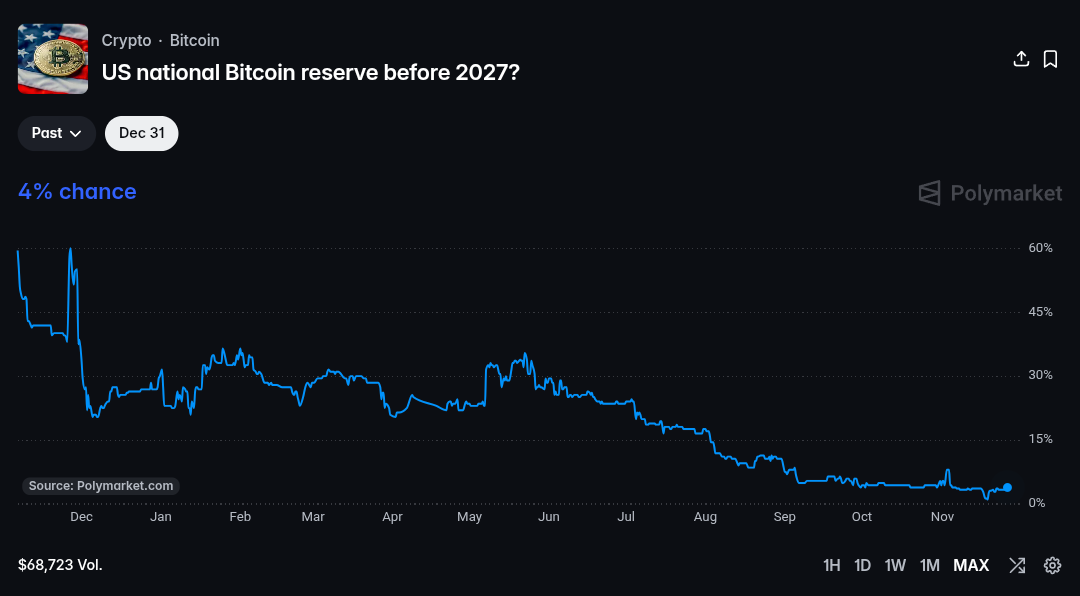
Adding to this, market expectations also remain pessimistic, with Polymarket traders assigning only a 4% probability to the U.S. establishing a national Bitcoin reserve through legislation before 2027.
All of this coincided with Bitcoin trading at $60,355.92 at press time after a hike of 2.1% in the past 24 hours.
Final Summary
- Bitcoin owned by the federal government through forfeitures would be transferred to the Strategic Bitcoin Reserve.
- The chances of the bill becoming law remain uncertain as the 119th Congress ends on 3rd January 2027.