Why $28B in weekend trading has Wall Street chasing crypto’s 24/7 model
Crypto’s 24/7 edge is being challenged as Wall Street moves toward round-the-clock trading, but blockchain infrastructure could keep DeFi competitive.


For years the crypto industry had one apparent advantage over the stock market: while Bitcoin [BTC] never sleeps, stock exchanges have their opening and closing times. But what happens when stocks begin trading almost around the clock as well?
TradFi is now chasing crypto’s 24/7 trading model
The stock market model is now starting to change.
In April, the SEC approved Nasdaq’s request to extend the hours for U.S. equity trading to 23 hours a day, five days a week, the new rules of which are coming into force on the 6th of December. Notably, the extended session will be from 9 p.m. to 4 a.m. ET. In addition to Nasdaq, NYSE is also planning to extend trading hours, hence moving towards an “always-on” market.
Naturally, the question arises: Why now?
According to the report, published by Binance, in recent months, weekend trading volume of TradFi’s perpetual futures, across crypto exchanges, has surged sixfold to $28 billion, with Binance alone accounting for nearly half the total volume.
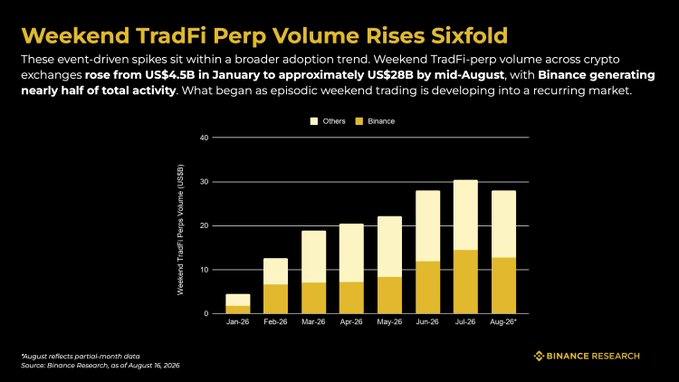
This is significant, as it is not merely a spike in weekend trading activity.
The data instead shows that traders are already using crypto markets to get 24/7 exposure to traditional assets, so TradFi’s push to offer “round-the-clock” trading makes sense. It aims to meet this demand by bringing more trading activity to traditional markets from crypto’s always-on markets.
Tal Cohen, President of Nasdaq, recently noted this shift:
The new wave of retail investors is already used to 24/7 crypto markets and as a result, equities are gravitating towards almost 24-hour trading and a willingness to allow pre-market and after hours trading. In other words, crypto has already normalized 24/7 trading and TradFi is now adapting to that demand.
Wall Street’s 24/7 push faces an infrastructure test
Extending trading hours is one challenge. Building the infrastructure to support continuous trading is another.
This “infrastructure challenge” is driving a rethink of clearing/settlement for TradFi participants. Nasdaq pointed out that with extended trading hours, clearing houses, brokers, and settlement systems need to run for longer, leaving less room for maintenance, risk checks, and batch processing.
The SEC has also pointed to challenges around clearing, collateral, payments, settlement, default management, cybersecurity, and liquidity as markets move towards continuous trading. SEC Commissioner Paul Atkins noted that longer trading could improve liquidity, but it could also fragment liquidity and impact price discovery and execution quality.
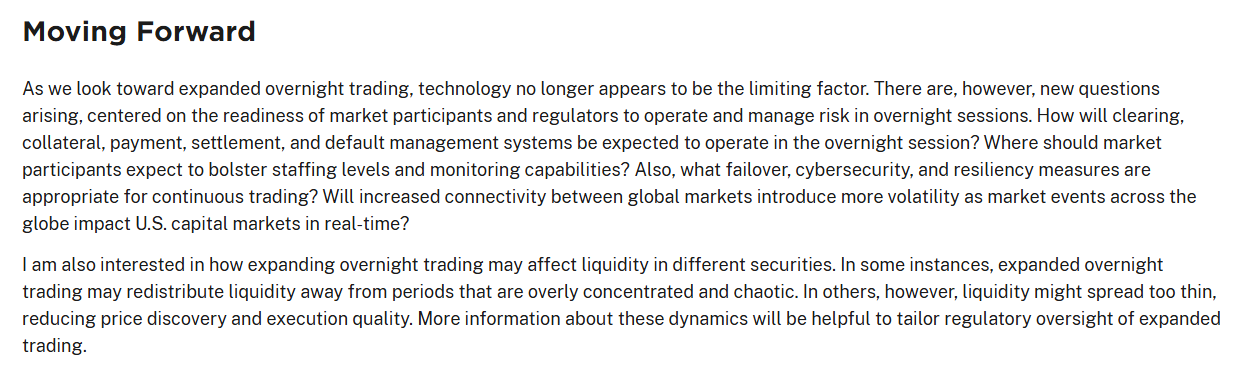
So, the issue for Wall Street is not simply about keeping the exchange open for longer.
Instead, the challenge lies in building an infrastructure capable of supporting continuous trading while maintaining high levels of liquidity, efficient settlement, and effective market oversight.
According to AMBCrypto, it is here that crypto provides an interesting insight. Blockchain networks already operate 24/7 with trading, settlement, and ownership all embedded within the technology. This raises a key question: As Wall Street starts moving towards always-on markets, could crypto’s ‘real edge’ be the infrastructure underneath it?
As TradFi goes 24/7, can it challenge DeFi’s core advantage?
Tokenization seems to be on the verge of an inflection point after years of experimentation. McKinsey estimates the total tokenized market to reach $2 trillion by 2030, with a bullish case of nearly $4 trillion. The main lesson is that tokenized equities will become one of the largest asset classes.
According to Blockworks data, total tokenized equities supply across all chains reached a record $3 billion, up from around $640 million at the beginning of the year, representing a 369% increase. The growth clearly highlights the growing appeal of tokenized equities as a way to access exposure to the equity market outside of regular trading hours.
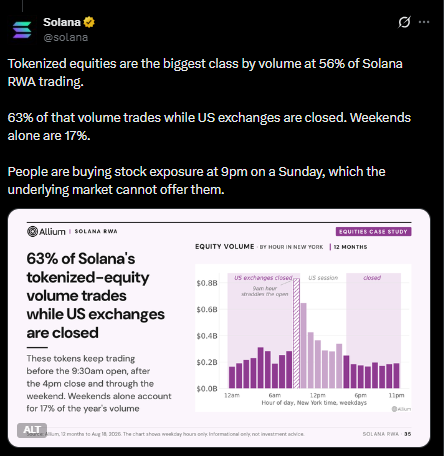
Solana’s [SOL] data shows how this trend is playing out. According to a recent report from Allium Labs, tokenized equities account for $8.2 billion of Solana’s $14.7 billion in total RWA trading volume, making them the largest RWA category. More importantly, 63% of this trading volume takes place when U.S. markets are closed.
This shows how investors are increasingly using blockchain rails to trade outside Wall Street hours, adding weight to the 24/7 trading debate.
In short, the infrastructure advantage is becoming clear. The growth in tokenized stocks is not only about the trading hours. It also points to the blockchain rails under them, as BlackRock CEO Larry Fink noted:
Tokenization could be the “next generation for markets.” The idea is simple: Move more of the market’s infrastructure on-chain, rather than just extending the hours of the existing system.
Always-on trading could reshape TradFi-DeFi competition
The shift of Wall Street towards 24/7 trading will erode one of crypto’s key advantages.
However, crypto’s advantage was never in providing 24/7 market access. As seen from the analysis above, one key insight stood out: Investors are already using blockchain rails beyond traditional market hours. Faster settlement, higher throughput, and tokenization further compound this advantage. The rise of Solana’s tokenized-equity market is a prime example of the ways financial assets are shifting on-chain.
This also means more competition between TradFi and crypto. As Wall Street adopts more crypto-like features, blockchain networks will have to keep pushing on speed, scalability, and efficiency.
Anatoly “Toly” Yakovenko, co-founder of Solana Labs, summed up this idea during his opening keynote:
We have an advantage because we can move faster, we’re global. A lot of these companies that have built their businesses around regulatory captured markets are stuck in the way that they do things. So we have an opportunity to disrupt them.
So, the bigger question is no longer who can trade 24/7.
Rather, it is who can build the infrastructure to make an always-on financial market faster, cheaper, and more efficient. Looking at where the market stands today and where it is going, DeFi could be in a strong position to play a bigger role in that shift.
Final Summary
- Wall Street is trending towards 24/7 trading, but crypto’s lead in settlement speeds and tokenization still gives it an edge.
- As the TradFi sector races to catch up, competition could be focused on the infrastructure and DeFi.