Why Bitcoin, stablecoins, and cards now share payment screens


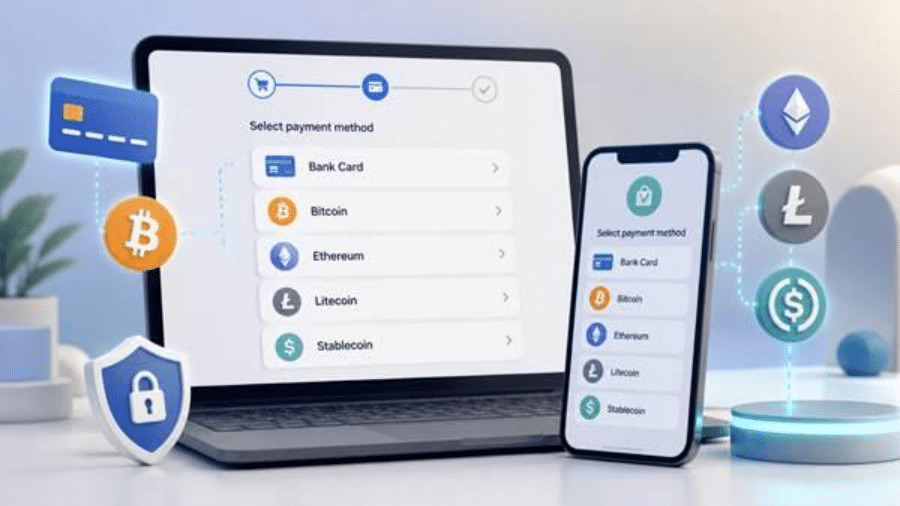
Crypto payment options are no longer a niche detail hidden behind the checkout button. They are becoming part of how digital platforms describe choice itself: card for familiarity, Bitcoin for recognition, Ethereum for ecosystem access, Litecoin for speed-minded users, and stablecoins for clearer denomination.
That shift matters because payment behavior is not one-size-fits-all. A Journal of Banking and Financial Technology study on digital payments and consumer experience found that trust, perceived usefulness, and previous experience shape how people approach digital payment methods. Crypto adds another layer to that same pattern. The question is no longer whether users prefer old rails or new rails. It is whether the available options match the way a person already thinks, stores value, and completes online actions.
Where multi-rail choice becomes visible
The idea becomes easier to understand when it appears in a live entertainment setting. In this case, Cafe Casino is a useful example because its public payment presence connects traditional card routes with crypto options, such as Bitcoin, Ethereum, Bitcoin Cash, Litecoin, and Tether, while its help pages explain that available crypto coins can depend on eligibility.
A lifestyle player may still prefer a card because it feels familiar and quick. A crypto-comfortable user may notice Bitcoin first because it is the most recognized digital asset. Someone already active across wallets may look at Ethereum, while another may prefer Litecoin or Tether because each supports a different payment mindset. In that sense, Cafe Casino shows the broader point clearly: modern payment choice is not about one method replacing every other method. It is about letting the payment route fit the user’s habits, comfort level, and preferred way to move from intention to action.
A simple visual can make that shift feel more immediate. This payment snapshot presents “Pay In More Ways” beside Bitcoin, Ethereum, Bitcoin Cash, Litecoin, Tether, Mastercard, and Visa. It works because the options sit together in one frame. Crypto is not treated as a separate universe, and cards are not treated as outdated. Payment choice now feels strongest when familiar and crypto-native routes can appear side by side
Choice is becoming a behavioral signal
Payment selection says more than “how will this be funded?” It reveals what kind of user someone is. A card-first user may value routine. A Bitcoin-first user may value recognition. A stablecoin user may want the amount to feel easier to compare with a familiar unit. An Ethereum user may already be thinking through wallet ecosystems, networks, and token movement.
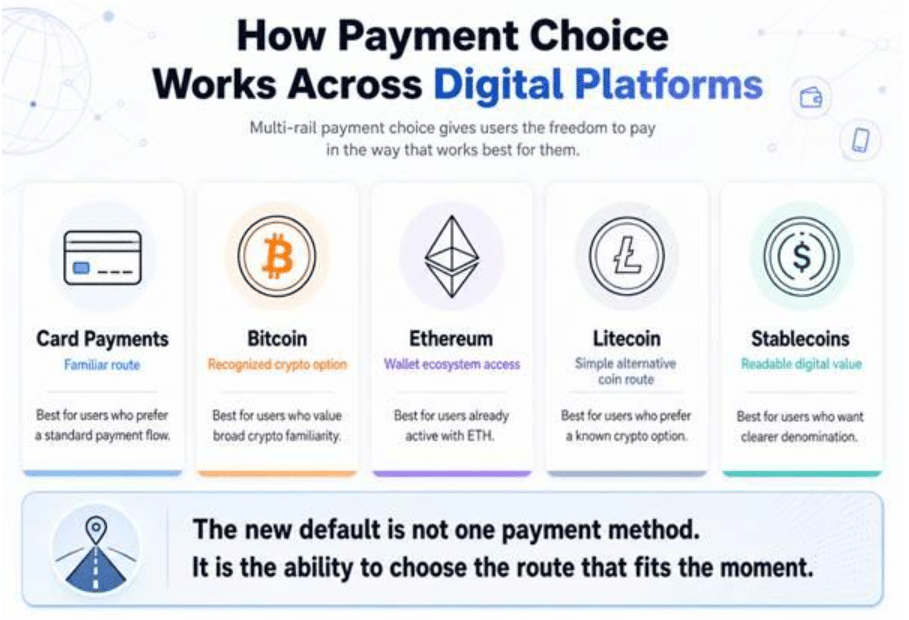
That is why multi-rail design has become more common across crypto-facing platforms. It gives users a way to match the moment. A quick entertainment session, a subscription, a wallet-based transfer, and a card-funded action can all have different emotional weight for the same person.
The key distinction is that payment choice is not always about being advanced. Beginners often benefit from choice when the options are labeled clearly and explained without pressure. More experienced users benefit when crypto routes are specific enough to prevent confusion. Both groups need clarity more than complexity.
Stablecoins changed the tone of the conversation
Stablecoins have made crypto payments easier to discuss with mainstream readers because they shift attention toward usability. Bitcoin and Ethereum are still major reference points, but stablecoins answer a different question: what happens when a user wants crypto payment access while thinking in a denomination that feels more familiar?
That does not make stablecoins the only route. It simply explains why Tether can sit beside Bitcoin, Ethereum, Bitcoin Cash, and Litecoin in a payment mix. Each option communicates a different user preference. The useful article angle is not “which one wins?” It is “Why are these options appearing together?”
This is where crypto payment options in 2026 feel more mature than earlier cycles. The conversation has moved away from novelty alone. Readers now care about which assets are supported, how clearly platforms explain the flow, whether card routes remain available, and whether the payment screen reduces uncertainty at the moment of action.
The new default is a range of defaults
The most important payment trend is not the disappearance of cards or the dominance of one coin. It is the rise of several defaults for different user types. A lifestyle player, a wallet-native crypto user, and a stablecoin-focused user may all arrive at the same platform with different expectations, yet each can still understand the available path if the payment choices are presented clearly.
For readers, the useful lens is simple. Strong crypto payment options make the payment moment easier to interpret. They show what assets are supported, how traditional and crypto-native routes coexist, and why choice works best when it respects different habits, instead of forcing one behavior.
That is the real direction of digital payments: not a single future, but a more flexible one where card familiarity, Bitcoin recognition, Ethereum access, Litecoin familiarity, and stablecoin readability can all play distinct roles. The thread running through all of this is consumer trust in cryptocurrency payments.
Disclaimer: This is a paid post and should not be treated as news/advice.