Why FASB’s ‘cash equivalent’ proposal could accelerate stablecoin adoption
Global banks still treat stablecoins as high risk.



The Financial Accounting Standards Board (FASB) has released a proposed rule seeking to treat stablecoins as “cash equivalents.”
The proposal is open for public comment until 19th November before the non-profit accounting rulemaker can finalize its guidelines on the same. According to the FASB, the move follows a 2025 consultation in which members raised the uncertainty of treating stablecoins in the balance sheet.
In response, the non-profit seeks to change the current definition of “cash equivalents” to accommodate stablecoins and certain digital assets. The rule requires firms to disclose what constitutes their “cash equivalents,” or less risky but highly liquid investments that can easily be changed for cash.
Impact of FASB proposal on stablecoin adoption
The FASB is responsible for setting accounting standards, commonly known as generally accepted accounting principles (GAAP). According to analysts, the move could signal a broader shift and accelerate stablecoin adoption.
For his part, Bankless’s David Hoffman claimed that the move is big and bullish for stablecoin firms.
Austin Campbell, Founder of crypto-focused consulting firm Zero Knowledge Group, echoed Hoffman’s stance and added,
It codified that for stablecoins (at least Genius ones), corporations will be able to hold them just like cash. Sensible decision by FASB and will help with adoption. Also now pressures bank regulators to fix B3!
For clarity, the GENIUS Act only mandates 1:1 backed stablecoins to be issued in the U.S. In other words, they’ll function as highly liquid and less risky, hence deemed as a “cash equivalent.”
Basel III (or B3, quoted by Campbell) refers to global banking regulations designed to foster financial stability. On the contrary, Basel III, formed to prevent a repeat of the 2007/2008 financial crisis, treats stablecoins as high risk, especially if it fails its redemption risk test.
Stablecoins, like USDT and USDC, which are on public and permissionless blockchains, are classified alongside Bitcoin and Ethereum and attract a 1250% risk weight. In other words, banks must hold 100% 1:1 US dollar backing for every asset held.
For comparison, traditional cash and government bonds attract zero risk weight while mortgages attract up to about 50% risk weight.
In fact, U.S Republican Senators, led by Cynthia Lummis, recently called for a repeal of these capital rules, calling them punitive and a de facto ban on crypto assets.
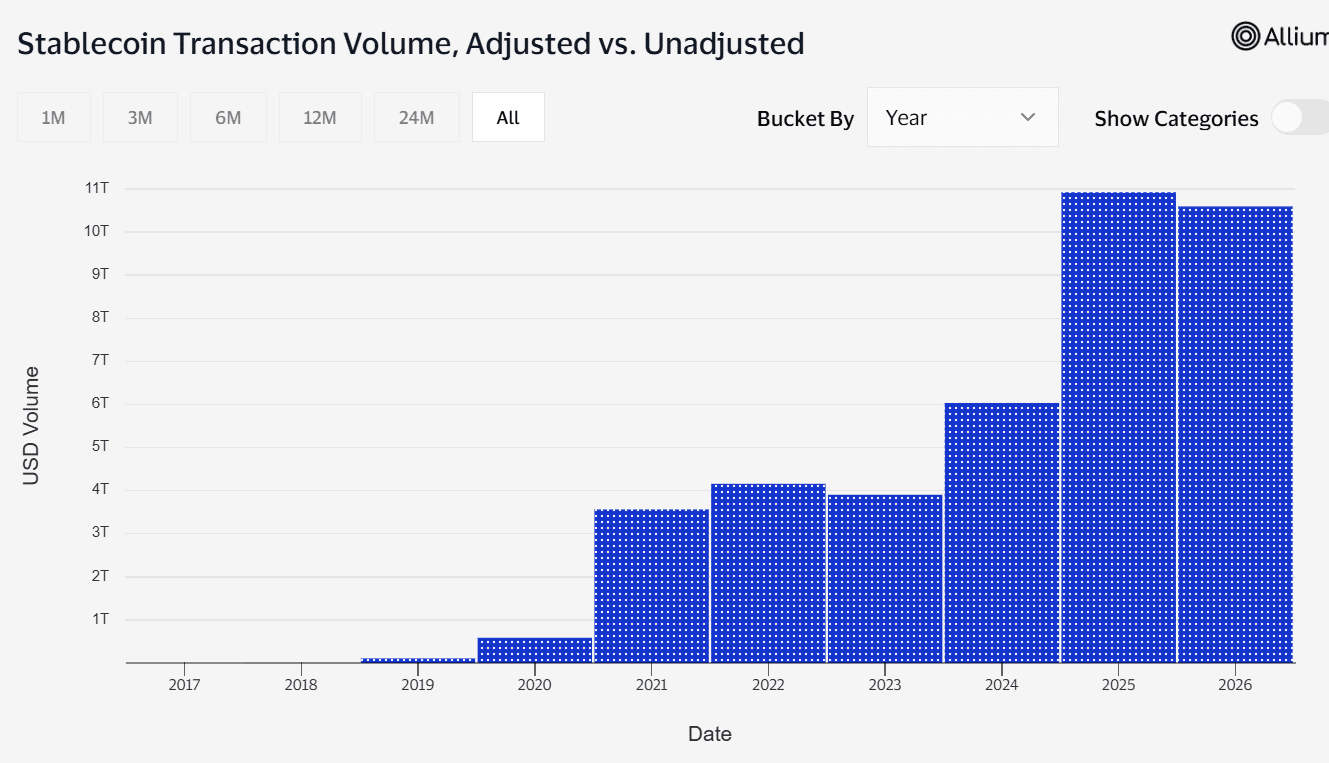
The ongoing pressure to update such rules follows greater adoption of stablecoins and crypto assets. Notably, annual stablecoin transfer volume hit a record $10.9T last year. With four months left to finalize 2026, the volume has hit $10.59T. In other words, another record milestone could be likely this year.
It remains to be seen whether the FASB move will force Basel III to re-evaluate its capital treatment of stablecoins.
Final Summary
- FASB seeks feedback on proposal to treat stablecoins as “cash equivalent.”
- Analysts believe that the move could force Basel III to relax its strict capital rules against crypto.