Algorand is a Layer-1 blockchain that centers its pitch on real-world asset tokenization, stablecoin payments, and quantum-resistant security. It runs on a Pure Proof-of-Stake (PPOS) network it says can clear roughly 10,000 transactions per second with instant finality and no rollbacks.
The protocol was founded in 2017 by Silvio Micali, an MIT professor and Turing Award-winning cryptographer whose work on zero-knowledge proofs and verifiable randomness underpins much of modern cryptography. Micali built the network around Pure Proof-of-Stake, a consensus model that assigns voting power in proportion to each holder’s stake and confirms blocks through a randomized committee that the protocol re-selects every round. This keeps fees low without the energy demands of proof-of-work.
Algorand has led blockchain quantum resilience since 2022, implementing Falcon signatures to protect its entire transaction history. And, in 2025, it executed the first quantum-resistant transaction on a live public mainnet while running carbon neutral since 2021. Around that core, Algorand has built out use cases spanning asset tokenization, payments and stablecoins, decentralized finance, supply-chain traceability, and humanitarian aid.
In fact, it has also pushed recently into agentic commerce, where AI agents and machines settle payments autonomously through the x402 standard.
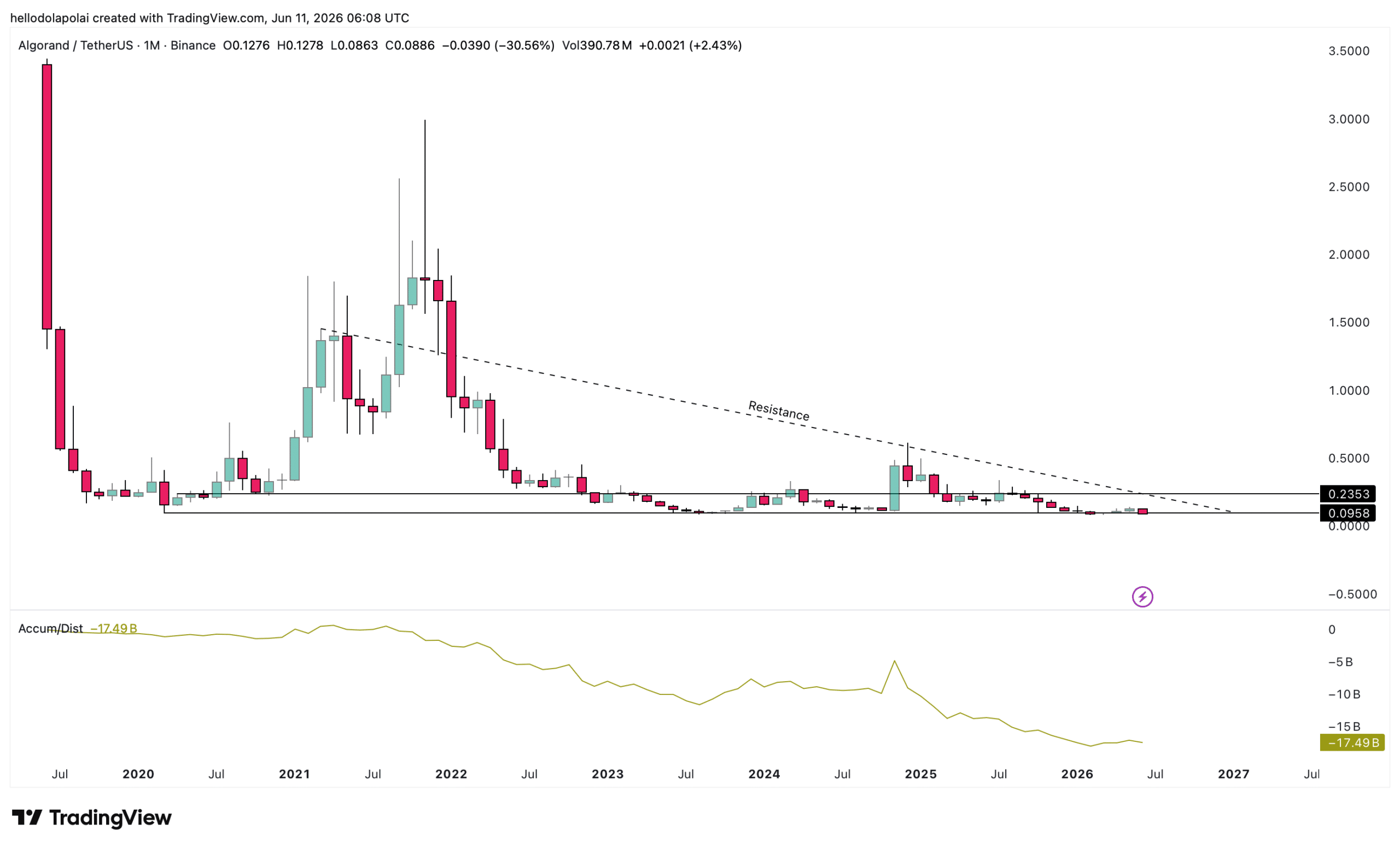
The initial code release came in April 2019. The Algorand mainnet went live in June 2019, positioning the network as a credible Ethereum alternative at a moment when working proof-of-stake chains were still rare. Algorand introduced its native token, ALGO, through a Dutch auction that let the market set the clearing level. The June 2019 sale cleared at $3.40 per token and raised $60 million.
That public sale followed a sustained private fundraising effort. Algorand secured an early $4 million seed round from Pillar VC and Union Square Ventures, then closed a $62 million raise in October 2018 from a global group of venture, cryptocurrency, and financial-services investors, taking total equity funding to roughly $66 million before mainnet.
Around that time the company installed Steve Kokinos as chief executive and Sean Ford as chief operating officer.
A separate ecosystem vehicle, the Algo VC Fund, raised $200 million in 2019 to back projects building on the network, doubling its original $100 million target with participation from NGC Ventures, and others. ALGO carries a fixed maximum supply of 10 billion tokens, with roughly 8.9 billion now in circulation, leaving the network close to its supply ceiling and easing the emissions pressure that shaped its early years.
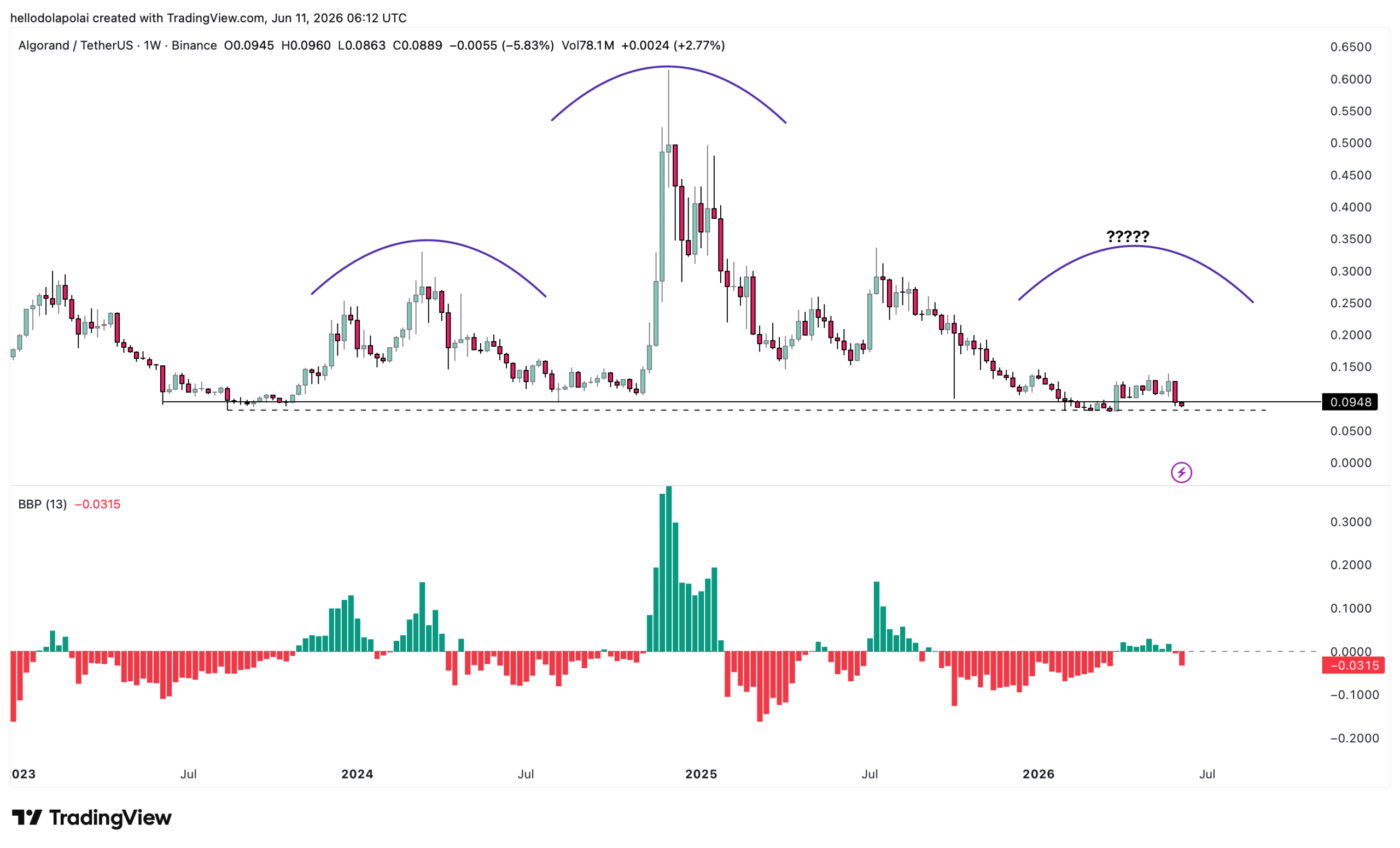
At the time of writing, the altcoin supported a market capitalization of about $801 million, placing Algorand around 60th among digital assets by that measure. At launch, by contrast, the network commanded a far larger valuation as early demand met a thin circulating float.
On-chain activity seemed modest relative to the network’s age and engineering ambitions too. For instance – Total value locked (TVL) across Algorand’s DeFi protocols stood near $32.3 million – A figure that hinted at limited capital depth in its lending, trading, and yield markets.
Stablecoin supply on the chain held around $60.2 million, anchored largely by USDC with a 96.7% dominance. The Algorand Foundation has historically leaned on payments and real-world asset use cases to widen that base, including USDC merchant settlement through the Swypt payment application.
The network is led in part by the Algorand Foundation, a not-for-profit established to manage community governance, oversee the token economy, and direct ecosystem funding. The Foundation operates alongside Algorand Technologies, the commercial entity that develops the core protocol.
In January 2026 the Foundation announced its return to the United States and a new board of directors. It now operates as a Delaware-based corporation.