COLDCARD bug goes undetected for 5 years despite 15 security reviews: Details
More than 240 customer accounts have been linked to COLDCARD's seed-generation incident.


Coinkite, the company behind Bitcoin [BTC] hardware wallet COLDCARD, has revealed that a security vulnerability remained undetected for more than five years, despite at least 15 independent security reviews, including AI-assisted research.
According to the 23rd November, 2026 postmortem published by Coinkite, the issue affected certain COLDCARD firmware versions released between 29th March, 2021, and 30th July, 2026.
Although the devices continued to generate valid recovery phrases and appeared to function normally, an underlying firmware error meant that the randomness used to create private keys was weaker than intended.
The five-year fiasco
That said, the issue stemmed from a software integration error that caused certain Coldcard devices to use a weaker pseudo-random number generator instead of the intended hardware-based system.
This generator produced less unpredictable recovery phrases, making it easier for attackers to guess the private keys and access users’ Bitcoin. Although the recovery phrases appeared normal and passed some security tests, they did not offer the expected level of protection.
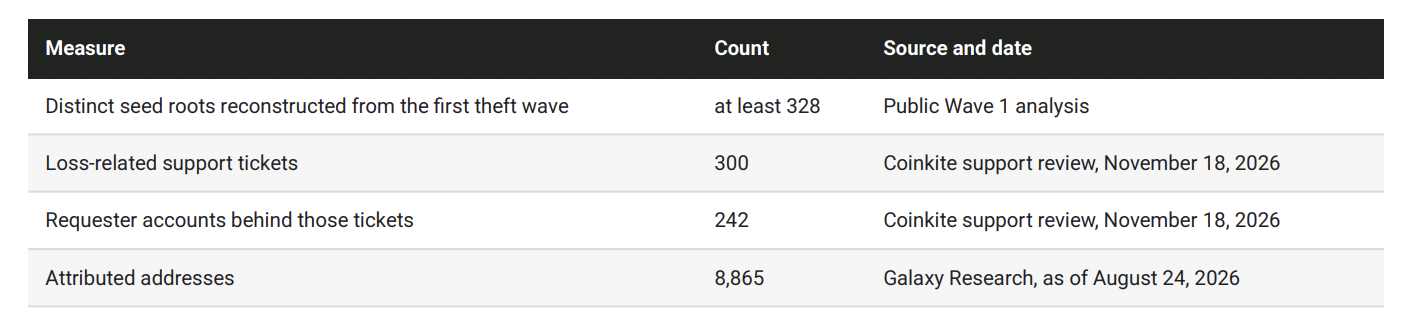
As a result, the vulnerability reportedly resulted in the theft of at least 1,789 BTC, worth approximately $114.7 million at the time. As of 18th November, Coinkite had received around 300 loss-related support tickets linked to 242 customer accounts. However, the actual number of victims could be higher.
That said, vulnerability significantly reduced the difficulty of reconstructing affected wallet seeds. According to Coinkite, the affected seeds had approximately 40 bits of effective entropy on Mk2 and Mk3 devices and 72 bits on Mk4, Mk5, and Q devices.
This was considerably weaker than the originally intended 128-bit security. This allowed attackers to use offline brute-force searches to reconstruct private keys and gain access to Bitcoin holdings without physically accessing the hardware wallets.
The fix is done, but…
However, Coinkite did address the issue on 31st July and introduced additional security measures in August. Yet, it is still investigating the incident alongside law enforcement authorities and the Canadian Centre for Cyber Security.
Up until now, the company has not finalized a compensation plan. Regardless, it has been advised that the affected users must generate entirely new recovery phrases and transfer their Bitcoin to new wallets.
This is because simply updating the firmware will not secure previously compromised recovery phrases.
Exploits continue to haunt the crypto community
All of this coincided with Ethereum researcher Justin Drake warning that artificial intelligence could potentially discover mathematical shortcuts to break the cryptographic systems protecting crypto private keys.
At the same time, crypto security losses surged 55% to $1.18 billion in Q3 2026, up from $763.97 million in Q2, while reported breaches increased from 67 to 107.
In that, compromised suppliers, delayed patches, and unaudited components accounted for 77% of losses, highlighting risks beyond smart contract vulnerabilities. Lastly, smart contract flaws also caused $569.5 million in losses, while access control and operational failures contributed to another $477.6 million.
Final Summary
- Coinkite received around 300 loss-related support tickets linked to 242 customer accounts.
- Users continued creating Bitcoin wallets without realizing that their recovery phrases were less secure.