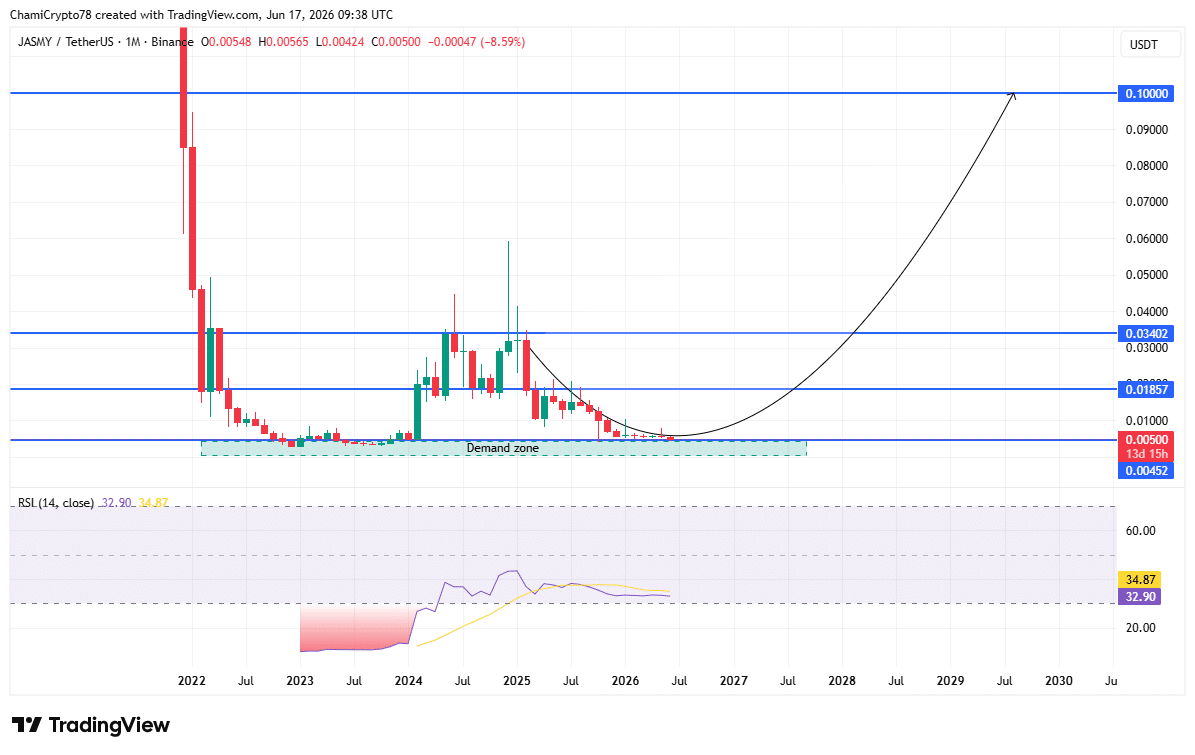
JasmyCoin [JASMY], often called “Japan’s Bitcoin,” launched on the 1st of October 2021 as the native token of Jasmy Corporation. The Tokyo-based blockchain company was founded in 2016 by former Sony executives, including Kunitake Ando and Kazumasa Sato. The project combines blockchain technology with the Internet of Things (IoT) and aims to give individuals greater control over their personal data.
At the center of the ecosystem are Personal Data Lockers (PDLs), which allow users to store sensitive information in encrypted environments. Enterprises can access that data only with user permission, creating a data-sharing economy where individuals retain ownership of their information.
JASMY functions as an ERC-20 token on Ethereum and serves as the ecosystem’s utility asset. Enterprises use the token to compensate users for access to valuable datasets. The model allows users to monetize personal data while addressing growing concerns around privacy, surveillance, and centralized data control. Beyond data transactions, JASMY supports network incentives, governance functions, and infrastructure-related costs.
The project follows a pre-mined token model with a fixed supply of 50 billion tokens. Approximately 49.44 billion tokens currently circulate in the market, representing more than 98% of the total supply. This distribution reduces future inflation risks compared to projects that still face large token unlocks. As a result, demand growth now plays a greater role in price performance than supply expansion. However, long-term value growth still depends on adoption, transaction activity, and ecosystem expansion.
JASMY also benefits from a strong regulatory foundation. Japan’s Financial Services Agency (JFSA) approved the asset, making it one of the first cryptocurrencies to receive recognition under the country’s regulatory framework. That status strengthens its credibility among enterprises and institutional participants that prioritize regulatory compliance.
The project remains heavily focused on Japan while gradually expanding into North America and Southeast Asia. Partnerships, enterprise collaborations, and initiatives such as the Jasmy Grant program support that expansion strategy.
From a technology standpoint, Jasmy combines blockchain infrastructure with IoT connectivity. Devices can generate, store, and share data securely without relying on centralized intermediaries. The approach addresses a common weakness in traditional IoT systems, where a small number of entities typically control large amounts of user data.
The platform supports several real-world use cases. In smart homes, users can manage and monetize data generated by connected devices. In healthcare, patients can share sensitive information while maintaining privacy controls. In supply chains, businesses can track and verify product data across multiple stakeholders.
The ecosystem has gradually shifted from concept development toward practical implementation. The team has also pursued integrations with decentralized storage solutions such as IPFS to improve data security and accessibility.
Even so, adoption remains the project’s biggest challenge. The model requires both enterprise demand and active user participation to succeed. Still, Jasmy’s focus on privacy, regulatory compliance, and enterprise applications gives it a distinct position within the broader crypto market.
As data becomes increasingly valuable across digital economies, JASMY’s user-controlled data model could gain relevance. Its long-term success, however, will depend on sustained network activity and continued ecosystem growth.