OpenUSD joins the stablecoin race, goes live with Coinbase, Mastercard, and Stripe
USDC's moat in stablecoin cards could at risk amid OpenUSD push in payment rails.


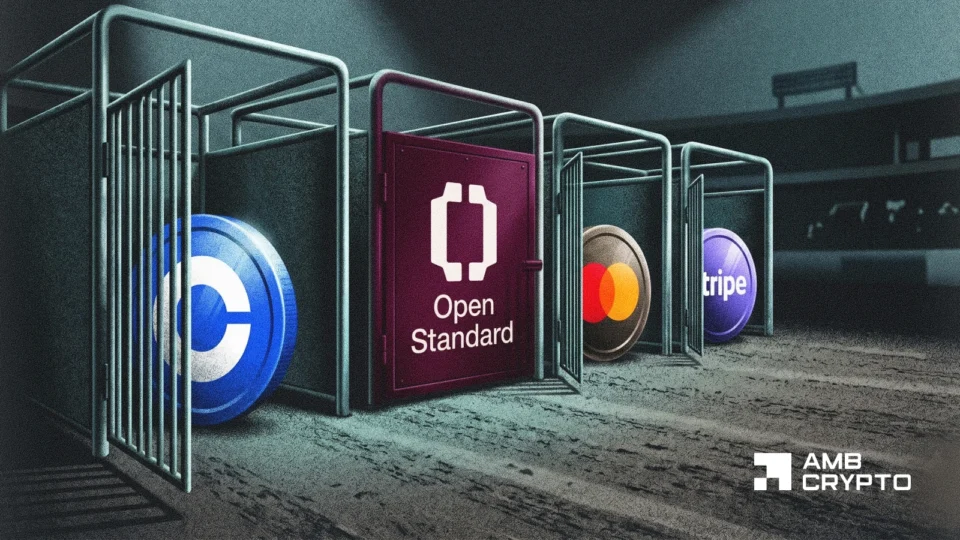
Stripe-issued OpenUSD went live across public blockchains on the 30th of September, formally declaring war on the stablecoin duopoly held by Tether’s USDT and Circle’s USDC.
The OUSD token, fully backed 1:1 to the U.S. dollar, went live across Ethereum, Solana, Base, and Tempo (Stripe-incubated network). All the participating partners will share the yield, according to Stripe CEO Patrick Collison,
Importantly, most yield is shared directly with partners rather than being internalized by the stablecoin issuer. Stripe is adopting OUSD in a number of core product flows.
During its initial public announcement in June, there were over 140 partners backing OUSD.
Most notably, the new stablecoin will be supported by Coinbase and three major payment giants: Stripe, Mastercard, and Visa.
Can OUSD challenge USDT-USDC stablecoin dominance?
And Coinbase’s support is quite curious. The exchange has an agreement with Circle and gets most of USDC’s generated yield from its reserves. Still, OUSD is a direct rival to USDC. However, Circle CEO Jeremy Allaire downplayed OUSD’s competitiveness, citing USDC’s network effects.
For his part, Jorn Lambert, Chief Product Officer at Mastercard, saw this as not a “winner-takes-all” scenario but as an adaptation to an increasingly multi-chain, “multi-money” future.
The challenge isn’t creating more forms of money. It’s helping businesses use them. It’s another step toward a more connected and interoperable multi-money future.
According to him, bank deposits, commercial card networks, digital assets, and stablecoins will operate within the same financial system. As such, infrastructure players should offer flexible options for users to pick what’s convenient for them.
In a multi-money world, the winners won’t be those who bet on a single form of money. They’ll be those who can use the right form of money for the right moment.
Unsurprisingly, Visa had adopted a similar neutral “multi-coin, multi-chain” approach.
However, Stripe, the OUSD issuer, is a major global payment integration giant. As such, it won’t be surprising if they go for USDT and USDC market share via OUSD. The firm tried to buy out PayPal and its stablecoin stack.
That said, USDC may be the immediate threat to OUSD’s overtures. In the regulated payments and consumer rails, USDC dominates with a 54% market share. This is the immediate OUSD target.
Hence, USDC could be challenged if Stripe and partners leverage their distribution network.
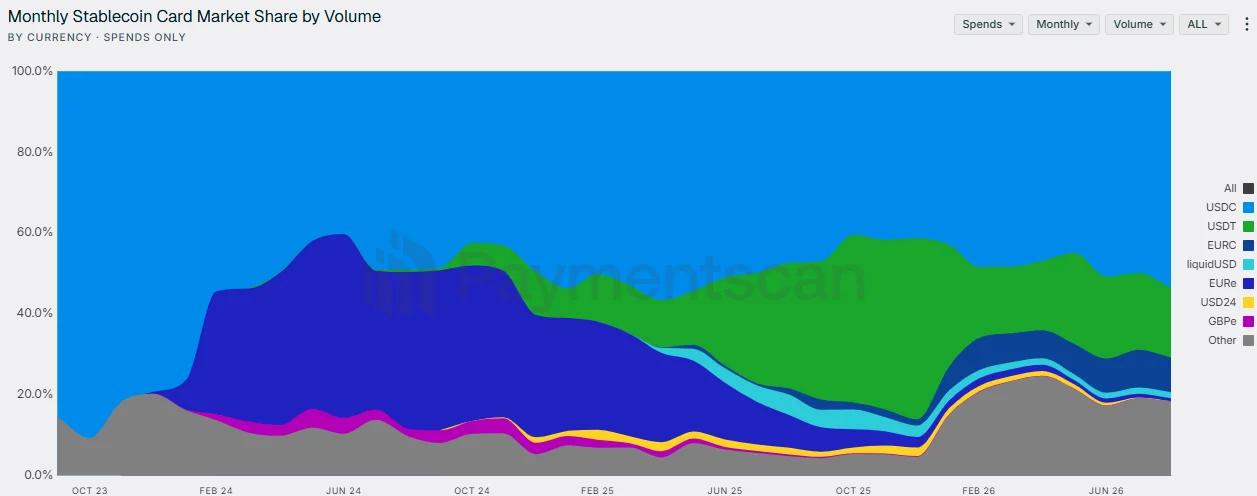
However, USDT is entrenched offshore as an inflation hedge in emerging markets, which most regulated stablecoins, including USDC, have found challenging to penetrate.
So, OUSD could rival USDC on regulated payment and consumer rails, but may face an uphill task against the world’s largest, USDT.
Final Summary
- OpenUSD went live on Ethereum, Base, Solana, and Tempo on Wednesday.
- USDC share in card spending could be at risk as OUSD challenges the stablecoin duopoly.